
The Tamil Nadu Chief Minister’s Girl Child Protection Scheme is a government welfare initiative designed to support the future of girl children and encourage families to provide them with better educational and financial opportunities.
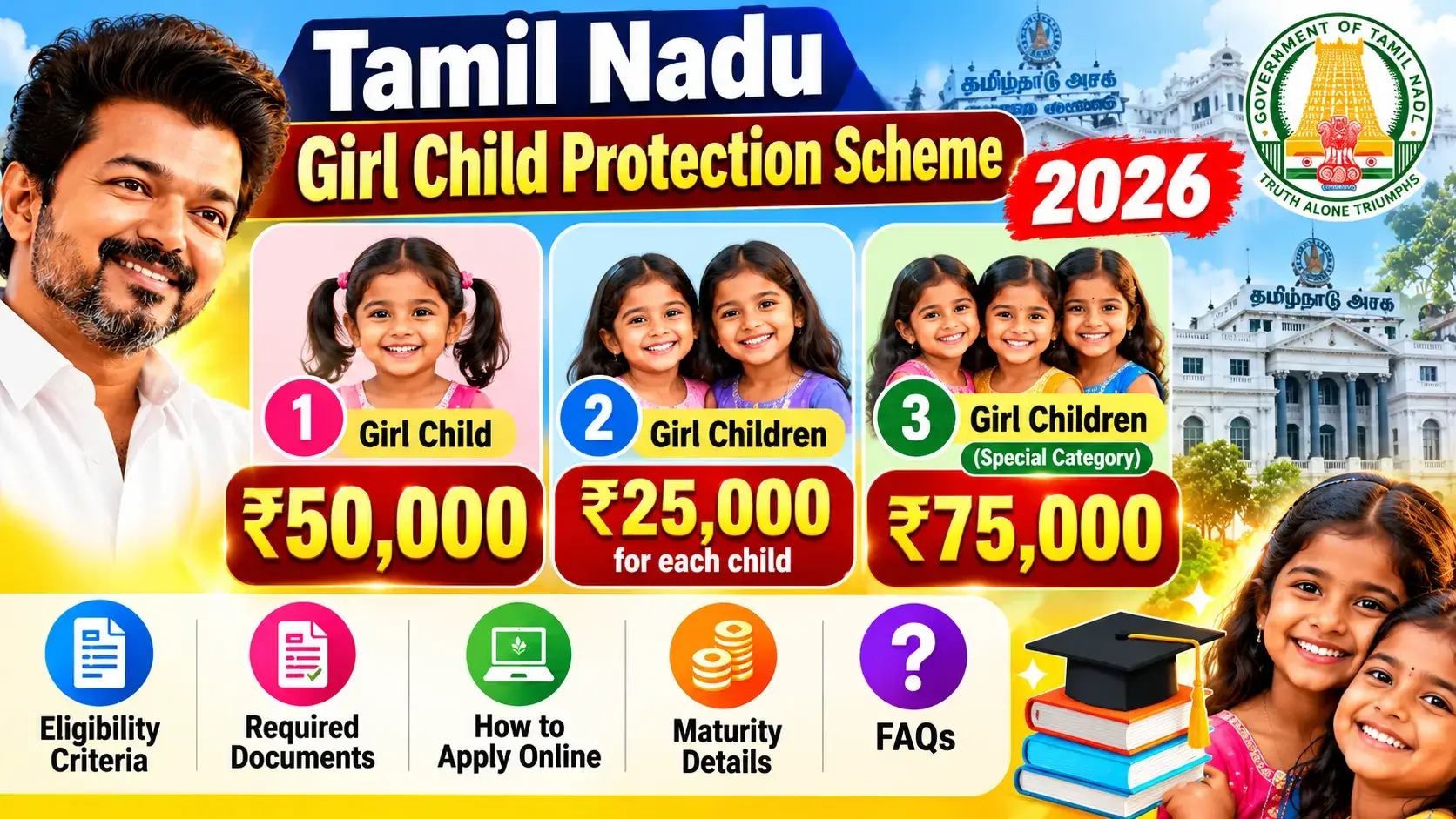
Under the scheme, an eligible family with only one girl child may receive a fixed deposit of ₹50,000 in the child’s name. An eligible family with two girl children may receive ₹25,000 for each child, subject to the applicable scheme conditions.
The deposit is maintained under the scheme’s prescribed rules, and the beneficiary may claim the maturity amount after completing 18 years of age, subject to the applicable eligibility requirements.
In this article, we explain the scheme’s benefits, eligibility criteria, required documents, application procedure, maturity conditions, official websites and frequently asked questions.
Important: Scheme rules, income limits, application deadlines and maturity benefits may vary depending on the applicable scheme provisions. Applicants should confirm the latest requirements with the Tamil Nadu Social Welfare Department before applying.
1. What Is the Tamil Nadu Girl Child Protection Scheme?
The Chief Minister’s Girl Child Protection Scheme is a welfare initiative implemented by the Tamil Nadu government through its social welfare administration.
The scheme aims to improve the financial security of girl children, encourage education and help eligible families build financial support for their daughters’ futures.
Instead of providing the entire financial assistance directly to the parents, the scheme provides for a fixed deposit in the name of the eligible girl child.
The deposit is maintained according to the scheme’s rules. Once the beneficiary reaches the prescribed maturity age and satisfies the applicable conditions, the maturity amount can be claimed through the designated process.
The scheme is particularly relevant to eligible families who want to create long-term financial support for their daughters’ education and future needs.
2. How Much Money Is Deposited for One Girl Child?
Under Scheme I, an eligible family with only one girl child may receive a fixed deposit of ₹50,000 in the child’s name.
| Particulars | Details |
|---|---|
| Scheme category | Scheme I |
| Eligible family | Family with only one girl child |
| Initial deposit | ₹50,000 |
| Beneficiary | Girl child |
| Deposit type | Fixed deposit under the scheme |
| Maturity age | 18 years, subject to scheme conditions |
| Final maturity amount | Depends on the applicable deposit terms and interest |
The ₹50,000 amount refers to the initial deposit, not a guaranteed maturity amount.
The family must satisfy the eligibility requirements, and the application must be approved by the competent authority before the benefit is provided.
Applicants should also check whether the rules applicable to their child’s birth date differ from those of older beneficiaries.
3. How Much Money Is Deposited for Two Girl Children?
Under Scheme II, an eligible family with two girl children may receive a fixed deposit of ₹25,000 in the name of each child.
| Beneficiary | Initial deposit |
|---|---|
| First girl child | ₹25,000 |
| Second girl child | ₹25,000 |
| Total initial deposit | ₹50,000 |
Each eligible child has an individual deposit under the scheme.
For example, if a family has two girl children and satisfies all the applicable requirements, the government may provide ₹25,000 for each child through the prescribed deposit arrangement.
Parents should keep the deposit certificates and application records safely because they may be required when claiming the maturity benefit.
4. Can a Family With Three Girl Children Receive ₹75,000?
Families with three girl children should carefully check the scheme’s specific provisions before applying.
Published scheme descriptions include a special category for a family in which:
- The first delivery resulted in one girl child.
- The second delivery resulted in twin girl children.
- The family satisfies the other applicable eligibility conditions.
Under this special category, the scheme provides for an initial deposit of ₹25,000 for each of the three eligible girl children, amounting to ₹75,000 in total.
However, this does not mean every family with three girl children automatically qualifies for ₹75,000.
If all three children were born in three separate deliveries, the family’s eligibility under this special category cannot be assumed. The family should contact the District Social Welfare Office to determine whether any other applicable provision or updated government order covers its circumstances.
Applicants should not rely on unverified social media posts or claims about a new announcement without checking the official notification.
5. Will a Girl Child Receive ₹3 Lakh After Completing 18 Years?
One of the most frequently asked questions about this scheme is whether a girl child will receive ₹3 lakh after completing 18 years of age.
The scheme provides for a deposit maintained according to its applicable rules. The beneficiary may claim the maturity amount after meeting the prescribed conditions.
However, ₹3 lakh should not be treated as a guaranteed maturity amount for every beneficiary.
The final amount depends on the original deposit, the applicable interest and deposit terms, renewals, the scheme category and other relevant rules.
A beneficiary whose initial deposit was ₹25,000 may not receive the same maturity amount as a beneficiary whose initial deposit was ₹50,000.
For an accurate calculation, parents should refer to the original deposit certificate and obtain the current maturity calculation from the designated financial institution or relevant government office.
6. Major Benefits of the Scheme
The important benefits of the Girl Child Protection Scheme include:
- Financial security: A deposit is created in the eligible girl’s name.
- Support for future education: The deposit can help provide financial support for the beneficiary’s future needs.
- Long-term savings: The money is maintained according to the scheme’s prescribed deposit rules.
- Maturity benefit: Eligible beneficiaries can claim the maturity amount after satisfying the applicable conditions.
- Educational assistance: Published scheme descriptions also refer to an annual educational incentive beginning in the sixth year. Beneficiaries should confirm the current amount and payment conditions with the department.
The scheme is intended to provide long-term support rather than unrestricted immediate cash assistance.
7. Who Is Eligible for the Scheme?
Applicants should verify the following eligibility requirements before submitting an application.
Number of girl children
The scheme includes different categories for eligible families with one girl child or two girl children.
A special category is also described for certain families with three girl children, where the first delivery resulted in one girl and the second delivery resulted in twin girls.
The applicable category depends on the family’s circumstances and the official rules.
Annual family income
Published district-level scheme descriptions have specified an annual family income limit of ₹72,000.
Applicants should confirm the current income limit and the applicable conditions with the District Social Welfare Office before applying.
Tamil Nadu residence requirement
The scheme includes a residence-related eligibility condition. Published descriptions refer to the parents or grandparents having lived in Tamil Nadu for the prescribed period.
Applicants may be required to submit residence or nativity documentation.
Family-planning requirement
The scheme has included a family-planning surgery requirement for a parent, subject to prescribed conditions.
Because age limits and other details may differ between older and current scheme descriptions, applicants should confirm the applicable rule with the department.
Child’s age at the time of application
Published guidance indicates that applications may need to be submitted before the girl child reaches three years of age under Scheme I, or before the second girl child reaches three years of age under Scheme II.
The applicable deadline should be confirmed before submitting an application.
Other conditions
The scheme also contains conditions relating to the presence of male children and adoption. Families should ask the department to confirm the exact provisions applicable to their case rather than assuming eligibility based only on the number of girl children.
8. Documents Required for the Girl Child Protection Scheme
Applicants may be asked to provide the following documents, depending on the scheme category and the family’s circumstances.
- Birth certificate of the girl child.
- Aadhaar cards of the parents.
- Family card or Smart Ration Card.
- Family income certificate.
- Residence certificate or nativity certificate.
- Community certificate, where required.
- Family-planning surgery certificate.
- Documents required to establish the family’s eligibility regarding the number of children.
- Age proof of the parents, where required.
- Family photograph, if requested.
- Supporting residence documents.
- Any additional documents required by the competent authority.
The exact document list may vary according to the applicant’s circumstances and the latest government instructions.
Carry the original documents and photocopies when visiting an e-Sevai centre or the relevant government office.
9. How to Apply for the Tamil Nadu Girl Child Protection Scheme
Applicants should check the official government service information before beginning the application process.
Step 1: Visit the official e-Sevai website
Open the Tamil Nadu e-Sevai portal:
Official website: https://tnesevai.tn.gov.in/
Look for the Social Welfare Department services relating to:
- Chief Minister’s Girl Child Protection Scheme I.
- Chief Minister’s Girl Child Protection Scheme II.
Check whether the relevant service is currently available online and review the application instructions.
Step 2: Visit an authorised e-Sevai centre
If the application needs to be submitted through an e-Sevai centre, visit an authorised centre near you.
Tell the operator that you want to apply for the Chief Minister’s Girl Child Protection Scheme.
The operator can help you check the available service, required documents and submission procedure.
Step 3: Select the applicable scheme category
The scheme category depends on the number of eligible girl children and the family’s circumstances.
- Scheme I: For an eligible family with one girl child.
- Scheme II: For an eligible family with two girl children.
- Special category: For eligible families meeting the specific conditions for three girl children, including the prescribed birth arrangement.
Confirm the correct category with the authorities before submitting the application.
Step 4: Submit the required documents
Provide the birth certificate, family card, income certificate, residence proof, family-planning surgery certificate and other required documents.
Check that the names, dates of birth and other details match across the documents.
Incorrect or incomplete information may delay the application.
Step 5: Obtain the application receipt
After submitting the application, keep the acknowledgement receipt or application reference number, if provided.
This information may be needed to check the application status or communicate with the relevant government office.
Step 6: Collect and preserve the deposit details
If the application is approved, obtain the deposit certificate or other official documentation confirming the benefit.
Check the child’s name and deposit amount carefully.
Keep the original document safe because it may be required when applying for the maturity benefit.
10. How to Claim the Maturity Amount After 18 Years
A beneficiary who has completed 18 years of age can approach the relevant authority to begin the maturity-claim process, subject to the scheme rules.
The following documents may be required:
- Original deposit certificate or the relevant deposit reference number.
- Beneficiary’s photograph.
- Identity documents of the beneficiary and parent, where required.
- Bank passbook or bank account details.
- Class 10 examination participation proof, such as a mark sheet or school certificate.
- Aadhaar or other accepted identity documents.
- Maturity-claim application form.
- Any additional documents requested by the competent authority.
Published scheme descriptions specify participation in the Class 10 public examination as a condition for receiving the maturity benefit.
Applicants should contact the District Social Welfare Office or designated institution to obtain the correct claim form and current maturity calculation.
Beneficiaries who have already completed 18 years of age but have not claimed their deposit should also check whether any current district-level instructions apply to their case.
11. Official Websites and Contact Information
Use the following official resources to check scheme details and application availability.
1. Tamil Nadu e-Sevai portal
Use this portal to check the availability of relevant government services and application instructions.
2. Tamil Nadu Social Welfare Department
https://www.tnsocialwelfare.tn.gov.in/
Visit the department’s website for government scheme information and official updates.
3. Chennai District Administration
https://chennai.nic.in/departments/social-welfare-sw/
Check the district’s Social Welfare Department information.
4. Mayiladuthurai District Administration
https://mayiladuthurai.nic.in/social-welfare/
Review the district’s published social welfare information.
If the online application service is unavailable or the eligibility conditions are unclear, contact the District Social Welfare Office or an authorised e-Sevai centre.
12. Frequently Asked Questions (FAQ)
1. How much money is deposited for one girl child?
Under the applicable Scheme I provisions, an eligible family with one girl child may receive an initial deposit of ₹50,000.
2. How much money is deposited for two girl children?
Under Scheme II, an eligible family may receive ₹25,000 for each girl child, making the total initial deposit ₹50,000.
3. Can a family with three girl children receive ₹75,000?
A special category has been described for families with one girl child in the first delivery and twin girl children in the second delivery. Families with three children born in separate deliveries should confirm their eligibility with the District Social Welfare Office.
4. Will the beneficiary receive ₹3 lakh at the age of 18?
A maturity amount of ₹3 lakh is not confirmed as a universal benefit for every beneficiary. The final amount must be calculated using the applicable deposit terms and the beneficiary’s official deposit records.
5. Is there an age limit for applying?
Published guidance indicates that applications may need to be submitted before the child reaches three years of age, depending on the scheme category. Confirm the current deadline before applying.
6. Can I apply online?
The Tamil Nadu e-Sevai portal provides government service information, including Social Welfare services. Check whether the relevant application is currently available online or must be submitted through an authorised e-Sevai centre.
7. What documents are needed to receive the maturity amount?
The beneficiary may need the original deposit certificate, bank account details, identity documents, Class 10 examination proof and the prescribed claim form.
8. Can every family apply for this scheme?
No. Applicants must meet the relevant conditions relating to family income, the number of children, residence, family-planning requirements, application deadlines and other scheme provisions.
Conclusion
The Tamil Nadu Chief Minister’s Girl Child Protection Scheme is intended to support the financial future of eligible girl children.
Under the applicable scheme provisions, an eligible family with one girl child may receive an initial deposit of ₹50,000, while an eligible family with two girl children may receive ₹25,000 for each child. A special category has also been described for certain families with three girl children.
Before applying, families should verify the latest eligibility conditions, required documents, application deadlines and available government services.
Do not assume that every beneficiary will receive ₹3 lakh at the age of 18. The maturity amount should be confirmed using the official deposit records and the applicable scheme rules.
Disclaimer: This article is for general informational purposes only. Government scheme rules and application procedures may change. Confirm all current details with the Tamil Nadu Social Welfare Department or the relevant district authority before applying.